
These types of scenarios occur more than a thousand times daily at organizations utilizing AI technologies for their security operations. And the timing for this technology could not be any better!
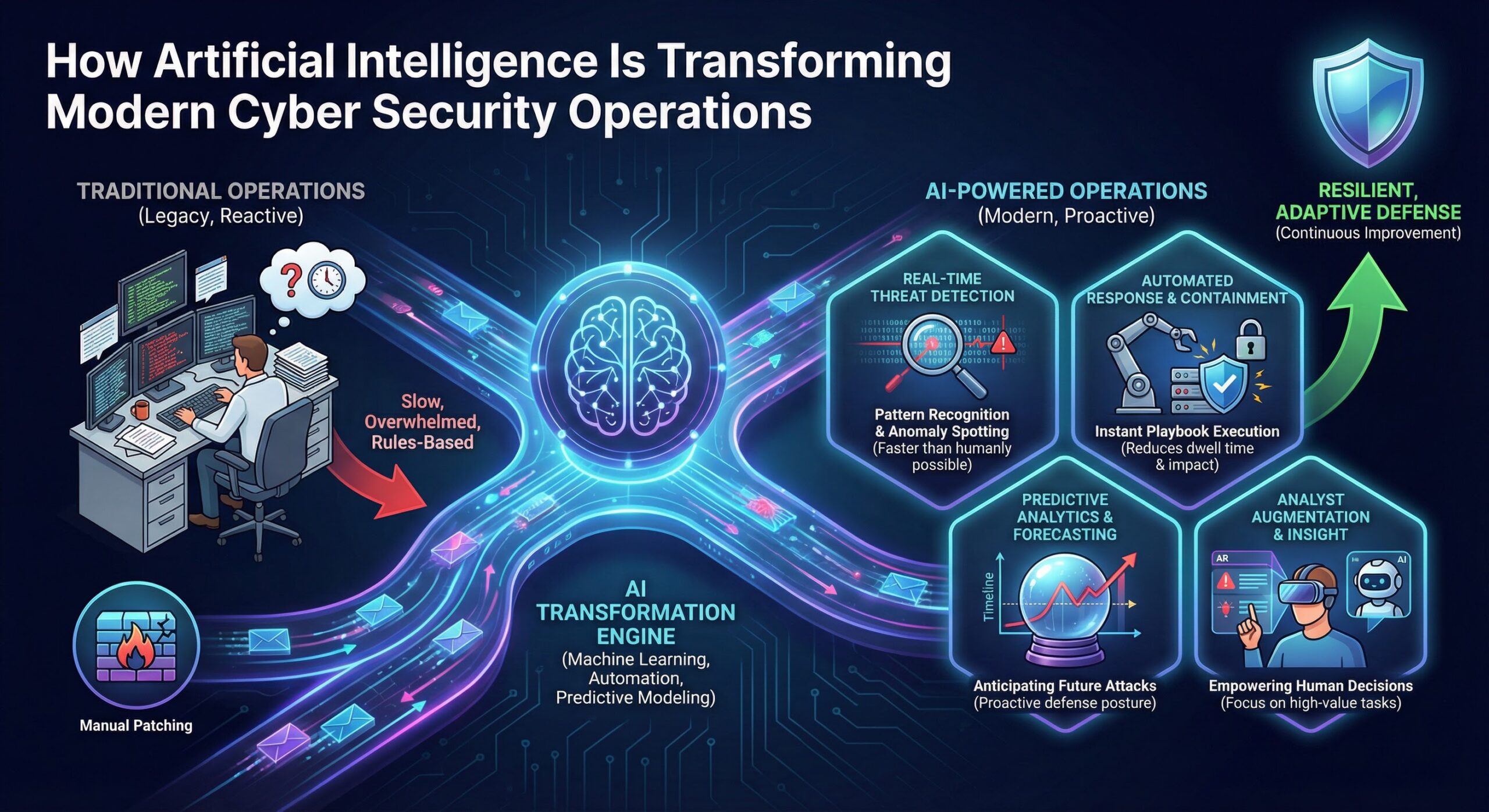
Cyber threats have evolved from nuisance-based viruses to extremely sophisticated attacks that can shut down an entire business in a matter of seconds. Traditional security measures are unable to keep up with the sheer volume, speed or complexity of today’s modern cyber threats. The introduction of artificial intelligence into how we protect digital assets is transforming the way we will ultimately safeguard them going forward.
The growth of the global artificial intelligence cybersecurity market is expected to reach $46.3 billion by 2027 (= 23.6% year-over-year growth). This rapid growth in the industry is indicative of one simple fact—defending against an ever-increasing intelligent attack requires equally intelligent defenses.
How Cyber Threats Developed Over Time From simple malware to more advanced cyber threats, computer security has changed a lot over the last few years.
Here’s the problem: cyber criminals use the same techniques as legitimate businesses. Cyber criminals utilize polymorphic malware that is constantly morphing to evade detection and automate attacks across millions or even billions of networked computers.
Facing the Volume Challenge Security teams have more challenges than ever before:
Behavioral Analysis: What is “normal”?
Typical network security methods validate an object against a database of known threats. But what if the threat has never been previously seen?
AI uses a different method of determining what the norm is by establishing baselines:
When deviation occurs from any of these baselines, at times even the slightest deviation, the system will trigger an alert that can catch the issue early on.
For example, if an employee who routinely accesses 50 files per day suddenly attempts to download 10,000 files at 2 a.m., this is something that an expert may not catch right away, but the AI will immediately flag this type of anomaly.
Pattern Recognition at Scale The machine learning models used in automated systems can evaluate patterns involving millions of data points at a time:
– Code samples used to differentiate between good code and bad code
– Network anomalies that may indicate someone is stealing data
– Credential/credentialing theft through methods that bypass static rule-based systems
Darktrace can identify and respond to potential attacks 100 times faster than traditional methods.
Finding What Other Defense Systems Can’t
Neural networks have the ability to find threats that other security systems miss:
– Zero-day exploits on unknown weaknesses of systems
– Fileless malware that operates solely in memory
– The existence of advanced and persistent threats that have been hiding within ‘normal/benign’ traffic for months
Automated Incident Response
Why Does Time Matter?
On average, it will take 207 days before a company discovers that they were breached, and it will take an additional 73 days to contain that breach. This means that the process of being attacked and resolved can take almost a year.
Artificial Intelligence can significantly reduce the time it takes to respond to a security event, from months to minutes.
How an AI-Driven Response Works
AI takes immediate action when it detects a potential threat:
– **Immediate Containment**
– Isolation of affected devices
– Updates to firewall rules
– User access removed
– Termination of malicious processes
– **Intelligent Decision-Making**
– Assessment of the severity of the threat (high, medium, low)
– Prioritization of incidents based on their impact on the business
– Recommendations for actions to be taken to remediate
– Use of pre-defined response plans to execute a response to the threat
In one year, Microsoft’s security AI has blocked over 70 billion email threats and 18 billion attempts to access malicious websites.
Security Orchestration, Automation, and Response platforms (SOAR) connect with existing security tools to:
– Collect information from multiple sources
– Analyze potential threats by using AI
– Automatically respond to confirmed threats
– Provide documentation of actions taken to demonstrate compliance requirements
As a result, a security analyst can reduce their workload by as much as 95% on repetitive tasks.
Moving from Reactive to Proactive with Predictive Security Analytics
Traditional security typically reacts after being attacked. AI can provide security organizations with predictive capabilities that allow them to predict and prevent breaches.
What do Predictive Analytics Predict?
-**Vulnerability Prediction:** AI analyzes code repositories, system configurations, and historical exploit data to predict which vulnerabilities will likely be exploited. – Attack Path Analysis: Machine learning mimics the actions of attackers in order to identify their points of entry, analyze their patterns of attack, and identify critical assets that may be compromised.
– Threat Intelligence Forecasting: AI uses data from around the world to identify new trends in attacks, as well as threats that are specific to an industry, and attacks that happen at certain times of year.
Statistics
Companies that are using predictive analytics reduce their number of breaches by 27 percent and also save approximately $1.4 million in incident response costs on average.
You Can Use It Too
– Endpoint Protection: CrowdStrike processes over 5 trillion events each week and has a greater than 99 percent success rate at detecting malware.
– Email Security: Proofpoint blocks 99.99 percent of all phishing email messages and also detects sophisticated attempts at stealing business email accounts.
– Network Security: Cisco SecureX monitors encrypted traffic, secures IOT devices, and protects cloud-based workloads.
– Identity Management: Okta detects when an account has been hacked, and implements risk-based authentication.
– SIEM: Splunk automates the process of triaging alerts, and enables predictive threat hunting on billions of logs.
Challenges and Limitations
Reality Check:
– Adversarial AI: Cybercriminals use artificial intelligence (AI) to develop advanced malicious software, automate reconnaissance work, and conceal their activity from law enforcement.
– False Positives: When using AI, false positives can have a negative effect on detection accuracy which leads to fatigue in alerting police or investigating true threats.
– Data Quality: AI requires large quantities of accurate and up-to-date training data in order to build an effective model.
One of the major problems with AI systems is they don’t have an explanation for the decisions made by the AI system. This can create compliance issues and troubleshooting.
The other issue that organizations deal with is that the implementation of AI takes a lot of resources – big computers, specialist knowledge and constant improvement.
The Future of AI in Cyber security With AI, it is important not to replace human professionals with machines, but to use a combination of:
– The processing capacity of AI and its ability to process data quickly.
– Human intuition combined with human context.
– The knowledge of the business (how the business operates).
– The ability of humans to make ethical decisions.
Emerging trends in AI in Cybersecurity
For example, one emerging trend is quantum-resistant AI (algorithms that are robust against quantum computing attacks) and the development of Autonomous Security Operations Centres.
AI’s future predictions for 2030 include:
– 75% of organizations will use AI-based security operations
– Accuracy of threat detection will improve by 60%
– All routine security functions will be automated.
According to Security boulevard AI-driven threat detection significantly reduces response time in modern SOC environments.
In conclusion, AI is altering the way that companies think of cyber security; it is removing barriers and will provide innovative opportunities to detect a threat in real time, as well as predict that same threat before it occurs.

nexasoftInfinity is a leading provider of SOC and cybersecurity solutions, empowering organizations to protect their critical assets in today’s ever-changing digital landscape.